

Hair Extensions
Hair Extensions in West Palm Beach: A Straight-Talking Guide

Extensions are the fastest way to add length and density — and the service where an honest consultation matters most, because they are not for everyone. Here’s a straight answer to the questions people actually ask before a first install.
The three main methods
Tape-in. Lightweight panels bonded flat against the scalp with adhesive strips. They’re quick to fit and comfortable, but as your hair grows the tape travels down and can become visible. They need re-taping every six to eight weeks.
Keratin-bond (K-Tip). Individual strands bonded to small sections with a keratin tip. They allow the most customized placement and the most natural movement, and they’re discreet. Re-application lands around every eight to ten weeks.
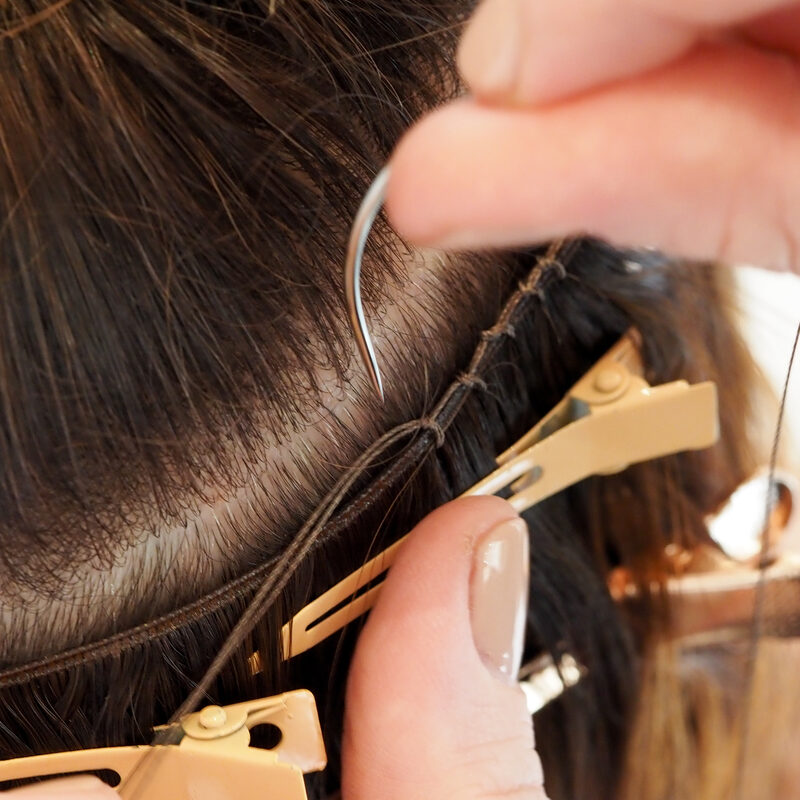
Hand-tied weft (sew-in). A weft stitched onto a small braided base rather than glued — no adhesive, nothing to peel or show. It takes longer to fit, holds longer between moves, and is the method we most often reach for with fine hair, because a braided base can be kept small and placed where the hair is densest. Our own installs are woven and color-matched by a colorist; the one-row and two-row sew-in are the backbone of what we offer here.
How long each lasts, and the upkeep
Every method grows out with your own hair, so the honest timeline is about maintenance, not “it lasts forever”:
- Tape-in: re-taped roughly every six to eight weeks.
- K-Tip: moved up every eight to ten weeks.
- Sew-in weft: a move-up every eight to ten weeks, where the weft is unbraided and restitched at the root. The hair itself is kept and re-used, so with reasonable care it carries through several installs.
Home care adds about five minutes a day: brush before washing, wash with sulfate-free shampoo, and never sleep on wet extensions. A base left damp is what shortens an install’s life, so dry it fully after every wash.
What it costs
We’re deliberately careful with this number, because it depends on the length you want, how much hair you need, and which method suits you. That’s why the salon publishes “Ask on booking” for its sew-in installs rather than a fixed figure — a quote that’s right for your head of hair beats a number that turns out to be wrong. The consultation itself is free, and that’s where you get a real number.
Who extensions suit — and who they don’t
Extensions can be excellent for fine hair, for added density, and for clients going through thinning or changes in density. But the honest answer is sometimes no: very fragile or damaged hair may need to be rebuilt first, and extensions shouldn’t be the first stop if the hair underneath isn’t healthy enough to hold them. That’s the assessment we do before anything is booked, not after.
Our extension specialists are also colorists, which is why the match tends to disappear into your own hair rather than sit alongside it. You can read more about the full extension methods and team, and see the complete price list for everything else we offer.
Considering extensions? Start with a free consultation at Red Market & Martial Vivot in West Palm Beach — reserve online.